![How Much Does It Cost to Hire a WordPress Developer in 2026? [USA Pricing Guide]](http://assets.goodfirms.co/goodtal/img/Blogs/image/wordpress-developer-cost-usa.jpg)
You Googled this because you are tired of vague answers.
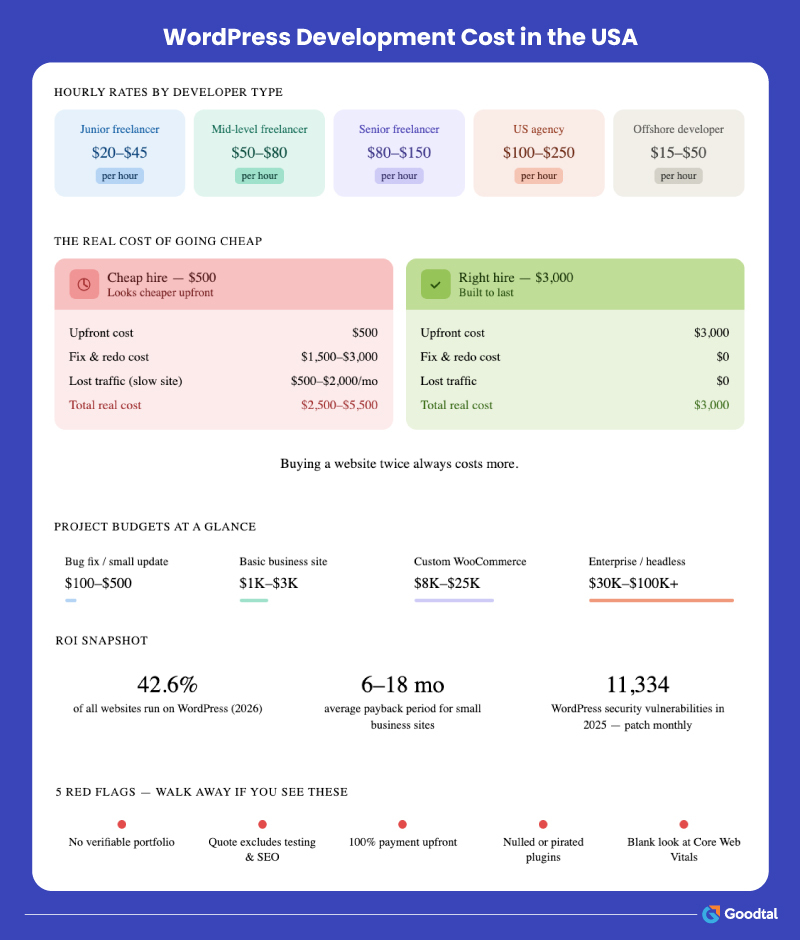
So here's the short version first: hiring a WordPress developer in the USA in 2026 will cost you anywhere from $20/hour to $250+/hour. Project-based, you are looking at $500 for a small fix to $50,000+ for a fully custom enterprise build.
The range is wide. We get it. That's exactly why this guide exists.
We'll break down what drives that cost, which type of developer actually matches your project, and how to avoid getting burned by a bad hire. Every stat below is sourced and linked.
WordPress Developer Cost at a Glance: 2026 USA Rates
Before anything else, here's the snapshot you need:
Developer Type | Hourly Rate (USA) | Best For |
Junior Freelancer | $20 – $45/hr | Basic fixes, theme installs, content updates |
Mid-Level Freelancer | $50 – $80/hr | Business sites, WooCommerce setup, custom themes |
Senior Freelancer | $80 – $150/hr | Complex builds, custom plugins, API integrations |
US-Based Agency | $100 – $250/hr | Ongoing support, full-service projects, enterprise |
Offshore Developer | $15 – $50/hr | Budget builds with longer timelines |
Sources: ZipRecruiter and Glassdoor
Freelancers billing you at market rates are typically in the $50–$150/hr range when hired directly. Agency overhead pushes that ceiling up.
Why WordPress Powers 43% of the Web and Why It Affects Your Developer Budget
WordPress powers 42.6% of all websites on the internet as of March 2026. It holds about 60% of the entire CMS market.
That dominance matters to your budget in a real way.
High demand for WordPress developers means more options but also a wider quality gap. More developers exist at every price point, from $5/hour freelancers on questionable platforms to $250/hour boutique US agencies.
Knowing that WordPress is the backbone of the modern web means a skilled WordPress developer is one of the highest-leverage hires a business can make.
7 Factors That Determine Your WordPress Developer Cost
Quotes for the same project can differ by 10x. Here's why.
1. Developer Experience Level
This is the single biggest cost driver. A junior dev charges less but may need more hand-holding. A senior dev charges more but moves faster and makes fewer expensive mistakes.
2. Project Complexity
A 5-page business site and a WooCommerce store with 500 SKUs are completely different beasts. Custom plugin development, complex API integrations, or headless WordPress builds will always cost more, and they should.
3. Hiring Model (Freelancer, Agency, or In-House)
More on this in its own section below. But the short version: freelancers are 20–40% cheaper than agencies. In-house is a salary commitment. Each model fits a different type of business.
4. Geographic Location
The same developer skill can cost $150/hr in the USA or $25/hr in Asia. This difference is because of the cost of living. US-based developers offer faster turnarounds, easier communication, and better accountability. Offshore developers are best for budget projects when communication is well managed.
5. Custom Design vs. Theme-Based
Using a premium theme cuts design time dramatically. Custom designs from scratch cost more and take longer. Most small businesses don't need a fully custom design.
6. Required Integrations
Need your site to talk to your CRM? Connect to a payment gateway? Sync with an ERP? Each integration adds scope and cost. A single clean API integration can add $3,000–$12,000 to a project.
7. Timeline Urgency
Rush projects cost more. It's that simple. If you need something done in 2 weeks that normally takes 6, expect to pay a 15–30% premium. Build in breathing room when budgeting.
Freelancer vs. Agency vs. In-House: Full WordPress Developer Cost Comparison
This is one of the biggest decisions you'll make. Here's what each model actually looks like in practice.
Model | Typical Cost | Best For | Watch Out For |
Freelancer (US) | $40–$150/hr | Defined projects, startups, lean teams | Availability gaps, scope creep |
Freelancer (Offshore) | $15–$50/hr | Budget projects, non-urgent work | Time zones, communication delays |
US Agency | $100–$250/hr | Full-service, ongoing retainer, enterprise | Higher costs, account managers |
In-House Developer | $70K–$120K/yr salary | Ongoing work, large teams | Benefits, overhead, management |
Sources: ZipRecruiter and Glassdoor
Where to Find Freelancers
- Upwork — Large pool, wide rate range. Vet carefully.
- Toptal — Pre-screened, premium talent. Expect premium rates.
- Codeable — WordPress-only platform. Vetted specialists. Average project rate: $70–$120/hr.
- Fiverr — Entry-level projects and small fixes only. Not for serious builds.
WordPress Website Development Cost by Project Type: What to Budget in 2026
Stop looking at hourly rates in isolation. What matters is the total project cost. Here's what real projects actually cost.
Project Type | Typical USA Cost | What's Usually Included |
Bug fix / small update | $100 – $500 | Isolated fix, quick turnaround |
Basic business website | $1,000 – $3,000 | 5–10 pages, premium theme, contact form, basic SEO |
Custom-designed site | $3,000 – $10,000 | Custom design, responsive, CRO-focused layout |
Small WooCommerce store | $2,000 – $6,000 | Product pages, cart, checkout, basic payment gateway |
Custom WooCommerce store | $8,000 – $25,000 | Custom design, integrations, inventory, advanced filters |
Membership / LMS / Booking | $10,000 – $35,000 | Custom functionality, user roles, payment workflows |
Corporate / Enterprise site | $15,000 – $50,000+ | Multi-team, complex CMS, performance, security |
Headless WordPress build | $30,000 – $100,000+ | Decoupled frontend, API-first, high-performance |
WordPress Developer Pricing Models: Hourly, Fixed-Price, and Retainer Explained
Not all projects are quoted the same way. Here's the honest breakdown.
Hourly Billing
Pay for the time spent. Simple.
Best for: Projects where the scope isn't fully clear yet. Ongoing tweaks, maintenance, or iterative builds.
Watch out for: Without clear hour caps and weekly reporting, costs can spiral. Always agree on a maximum hours cap upfront.
Fixed-Price Projects
One price, agreed upfront. No surprises — if scoped correctly.
Best for: Well-defined projects where you know exactly what you want. New website builds, specific feature development.
Watch out for: Scope creep is the killer here. Every 'small addition' turns into a change order. Write your brief in detail before getting quotes.
Monthly Retainer
Retainers are everywhere in 2026 — and for good reason. If your site needs regular updates, security patches, and bug fixes, a retainer makes more financial sense than ad-hoc hourly work.
Typical retainer costs in the USA: $50–$150/month for basic maintenance. $200–$500/month for active development support.
The upside: priority access, faster turnarounds, predictable costs. The downside: you're paying even in quiet months. Most good developers will roll over unused hours 1–2 months — negotiate this upfront.
Your Situation | Best Pricing Model |
Clear scope, defined deliverables | Fixed-price |
Ongoing updates and maintenance | Retainer |
Exploratory or evolving project | Hourly with cap |
Large enterprise build | Milestone-based fixed |
Small one-off fix | Hourly (1–2 hours) |
5 Red Flags When Hiring a WordPress Developer
A lot of buyers focus on price. Smart buyers focus on risk. Here's what to watch out for before signing anything.
1. No Verifiable Portfolio
Any serious developer has live sites you can visit. Run Google PageSpeed Insights on 2–3 of them. If the sites are slow, broken on mobile, or look dated, it is a big no.
2. Quote That Excludes Critical Items
Cheap quotes often exclude testing, SEO setup, post-launch support, and mobile optimization. Ask specifically what the quote covers.
3. No Milestone-Based Payment Structure
Never pay 100% upfront. Developers work in milestones. A deposit, a mid-project payment, and a final payment on delivery. If this is not the case, walk away.
4. Nulled Themes or Pirated Plugins
Nulled plugins are pirated. They contain malware and get no security updates. If a developer offers to save you money on premium plugins, that's a massive red flag. Premium plugins typically cost $50–$200 and are worth every cent.
5. Can't Explain Core Web Vitals
Google ranks sites partly on performance metrics called Core Web Vitals. If a developer looks blank when you mention Largest Contentful Paint (LCP), First Input Delay (FID), or Cumulative Layout Shift (CLS), they are not up to date. Ask every candidate: 'How do you approach Core Web Vitals on your builds?'
Is WordPress Development Worth the Cost? ROI and Long-Term Value
Let's talk about the question behind the question.
Most buyers aren't really asking 'how much does it cost?' They're asking: 'Is it worth it?'
Here's a more useful frame.
Your Website is a Revenue Asset, Not an Expense
A $10,000 website that generates 3 new leads per month at a $5,000 average client value pays for itself in less than a month. The question isn't 'is $10K expensive?' It's 'what will this website do for revenue?' Most small US businesses recover website development costs within 6–18 months.
The Real Cost of Going Cheap
A $500 developer from a no-vetting platform who delivers a broken, slow, unsecured site costs you more than a $3,000 specialist. You'll pay to fix it. You'll lose traffic because it's slow. You'll lose customers because it doesn't convert. Buying a website twice is the most common expensive mistake in this industry.
Maintenance is Cheap Insurance
WordPress had 11,334 security vulnerabilities in 2025, up by 42% from 2024, with 91% of them coming from plugins.
A $100–$150/month maintenance retainer to keep plugins updated, backups running, and security patched is one of the best small-business investments you can make. One hacked site can cost far more than a year of maintenance.
Getting the Most Value for Your Budget
Match the developer level to the project. Define your scope before you get quotes. Vet portfolios technically. Start with a trial task. And build in a maintenance budget from day one.
Do these things, and you will avoid 90% of the mistakes businesses make when hiring a WordPress developer.
Need a custom project estimate? Define your scope, shortlist 3 developers, and compare line-by-line and not just the bottom number.
Frequently Asked Questions
How much does a WordPress developer charge per hour in the USA?
Rates range from $20/hr for junior freelancers to $250/hr for senior US agency developers. The mid-market sweet spot for quality freelancers is $50–$100/hr. In-house employees average around $40–$42/hr in salary equivalent.
Is it cheaper to hire a freelancer or an agency?
Freelancers are typically 20–40% cheaper than agencies. Agencies offer more structure, project management, and team support. For ongoing work, a mid-market freelancer on retainer often gives you the best value per dollar.
How long does it take to build a WordPress website?
A basic business site takes 2–4 weeks. A custom design takes 4–8 weeks. A full WooCommerce store with custom features takes 2–4 months. Enterprise builds can run 4–12 months. Rush timelines cost more.
What's the difference between a WordPress developer and a WordPress designer?
A designer handles the visual side, layouts, colors, typography, and UX. A developer handles custom functionality, plugin development, performance, and integrations. Many mid-level professionals do both. Complex projects often need separate specialists.
Can I hire a WordPress developer from India for a US project?
Yes, and it's common. Offshore developers typically charge $15–$40/hr compared to $50–$150/hr in the USA. The tradeoffs are time zone overlap, communication speed, and direct accountability. For clearly scoped projects, offshore can work well. For ongoing strategic work, a US-based developer often delivers better ROI.
What should be in a WordPress developer contract?
At minimum: scope of work, milestone schedule, payment terms, revision policy, who owns the code post-delivery, a post-launch support window, and a clause covering what happens if deadlines are missed. Never skip the contract.

Myra Williams
Senior Content WriterA computer engineer turned writer, Myra has spent the past seven years helping readers understand technology without the buzzwords. At Goodtal, she shares honest perspectives and easy-to-grasp insights that make choosing the right tools feel simple and informed.